Small Targets
Vehicles, people, and other relevant objects may occupy only a small fraction of the frame, making global visual summaries unreliable.
spatial focusRemote-sensing video understanding · CVPR 2026 public version
A continuous-video benchmark and evidence-aware training framework for finding the right target, frame, and scene context before answering.
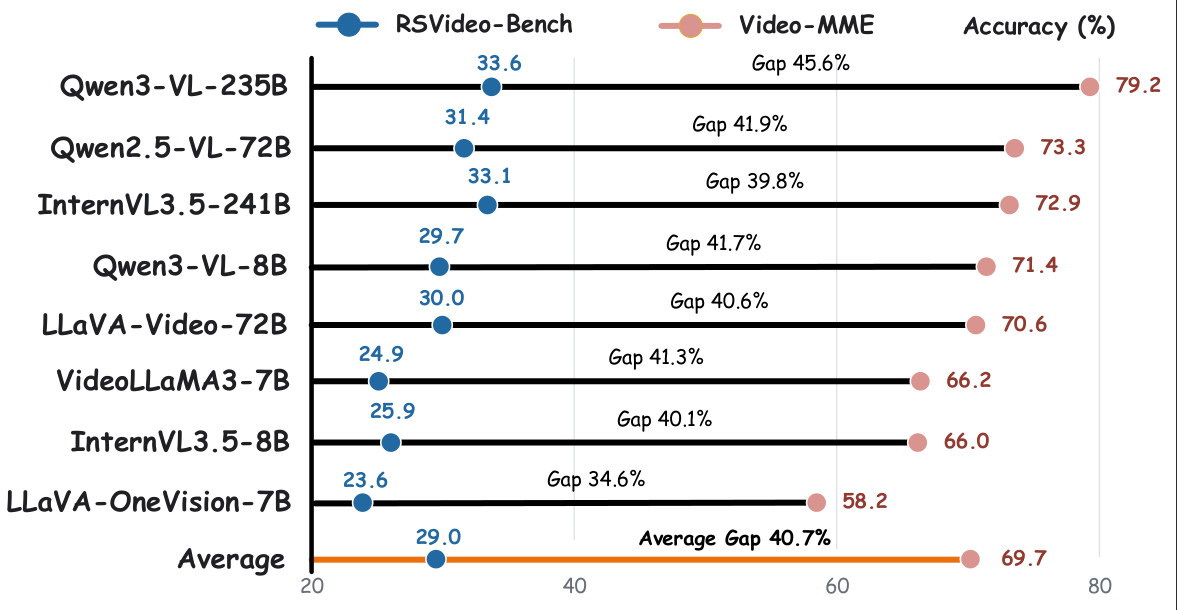
The question
RSVideo studies continuous video question answering from UAV and satellite viewpoints. The benchmark asks models to identify small targets, follow short-lived events, and reason over spatial and temporal relationships that are easy to miss when the evidence occupies only a few frames or pixels.
Our central observation is simple: a correct answer depends on knowing where and when the evidence appears, not only on recognizing the scene category.
Why this is different
Overhead viewpoints, repetitive textures, and fast-changing targets create a gap between seeing a scene and explaining what happened inside it.
Vehicles, people, and other relevant objects may occupy only a small fraction of the frame, making global visual summaries unreliable.
spatial focusActions and state changes can last for only a brief temporal window. A few sampled frames may erase the event that answers the question.
temporal focusAnswers often depend on roads, buildings, boundaries, nearby targets, movement direction, and the order of multiple events.
spatiotemporal reasoningDataset
Every item is a five-choice question grounded in a released video clip. RSVideo-Instruct supports training and validation, while RSVideo-Bench is a locked test set for controlled evaluation.
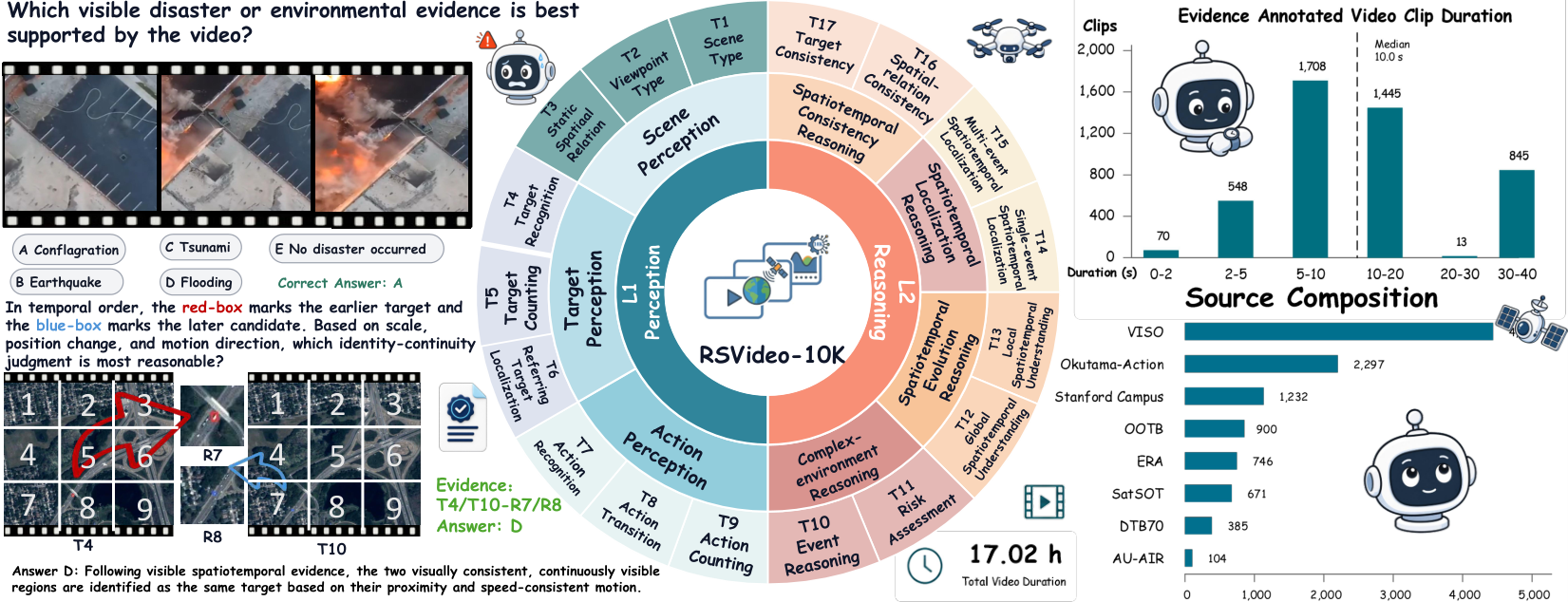
All questions use one shared annotation protocol. Evidence fields identify the relevant temporal window and, when needed, the spatial target region. The fixed test set contains 653 Perception items and 2,078 Reasoning items.
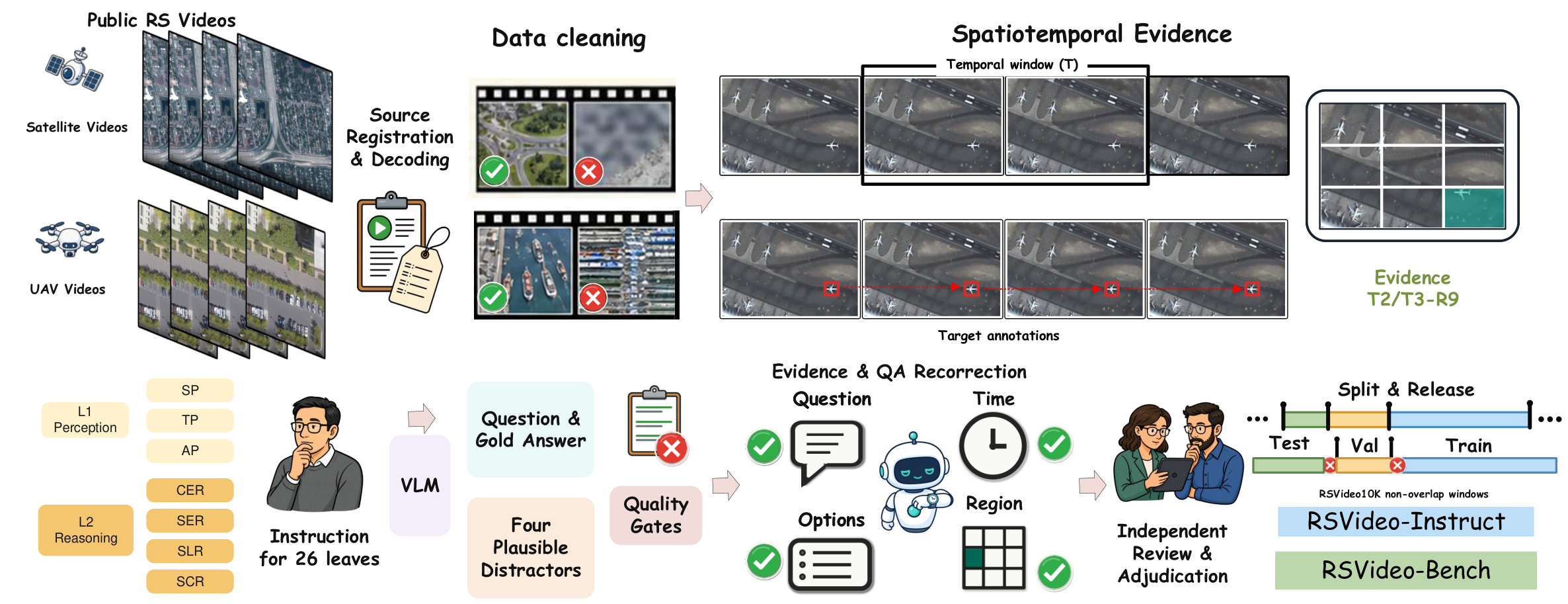
Task taxonomy
The taxonomy separates what a model can perceive from how it reasons about change, relations, and evidence across time. The groups below summarize the two capabilities; the full benchmark contains 17 fine-grained subtasks.
RSVideo-Bench
All models receive the same video question and five answer choices. Scores are computed over the fixed 2,731-item test set, making it possible to compare backbones and training strategies under a shared input and evaluation budget.
Scene, target, and action perception tasks test whether the model can identify the relevant content in overhead video.
653 itemsReasoning tasks connect targets, relations, trajectories, state changes, and temporal order across multiple frames.
2,078 itemsMethod
Evidence-aware initialization and reinforcement learning work together to select informative spatiotemporal tokens while compressing redundant background context under a fixed visual-token budget.
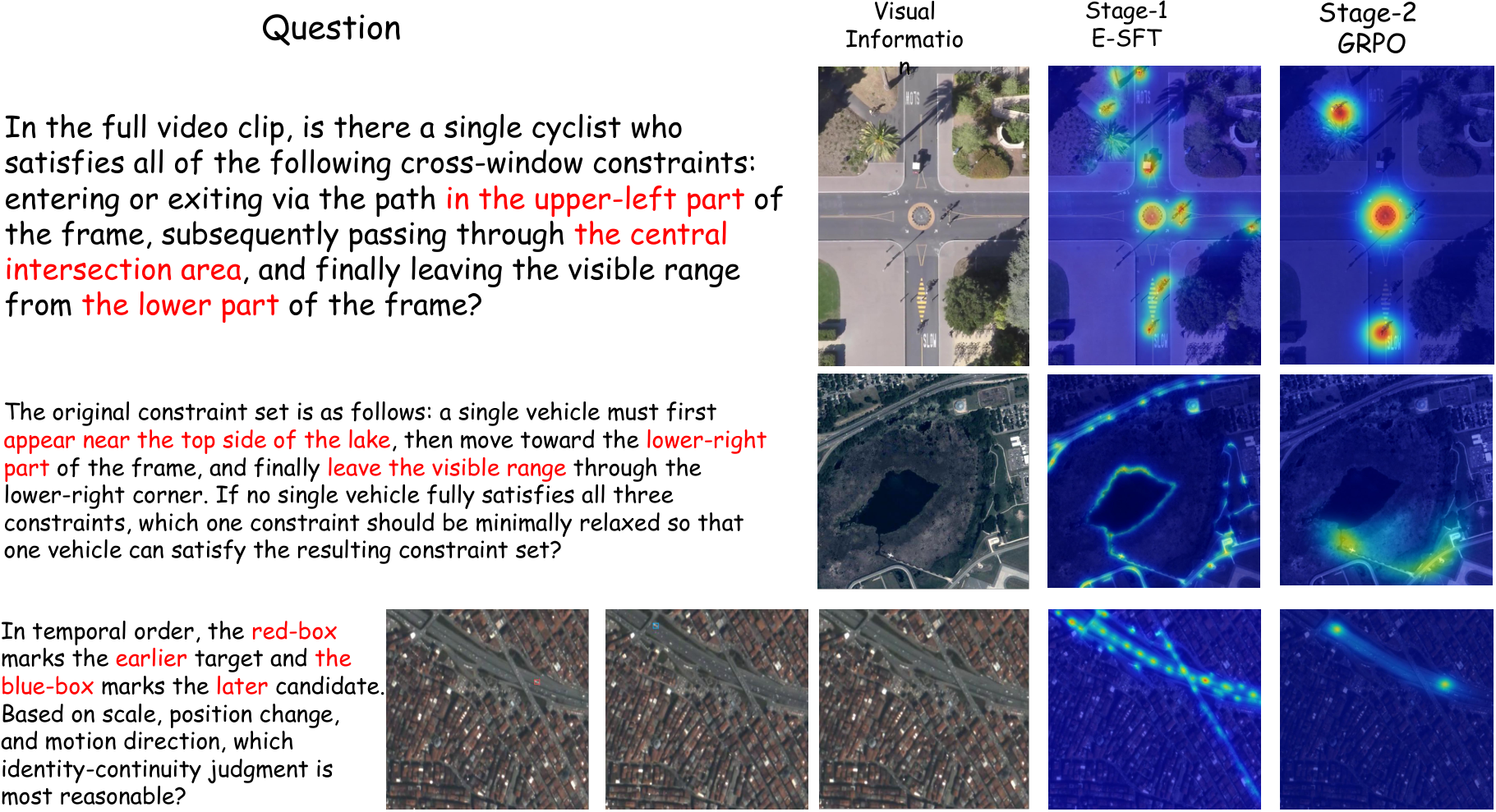
Results
Across a diverse set of vision-language backbones, evidence-aware training consistently improves performance on the fixed RSVideo-Bench test set.
Models that perform well on natural videos still struggle when relevant evidence is small, distant, and distributed across time.
Qualitative examples
Each example highlights a different way the answer depends on localized visual evidence instead of a single global scene impression.
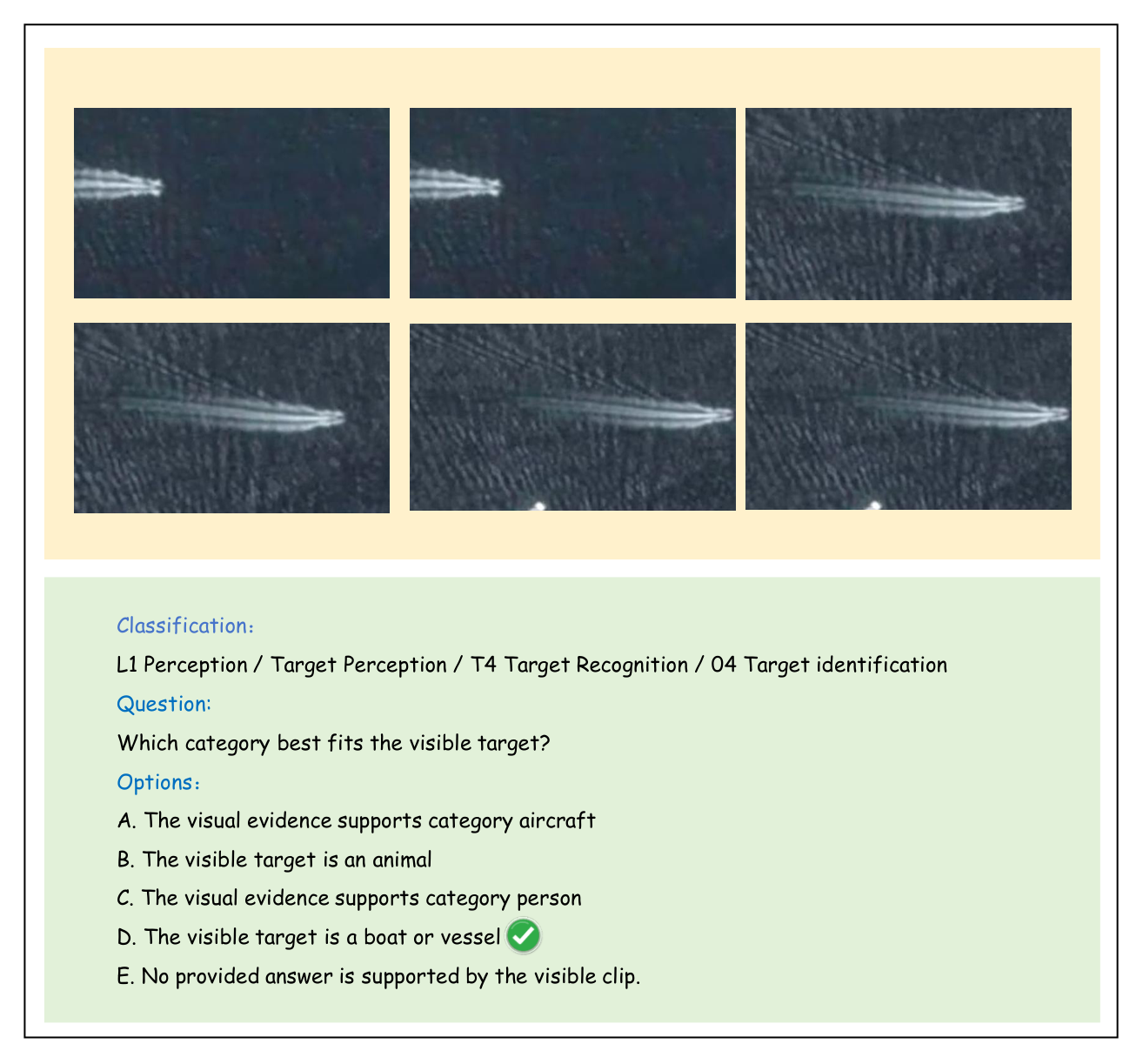
Which object is the question referring to?
Evidence: local appearance and scene context.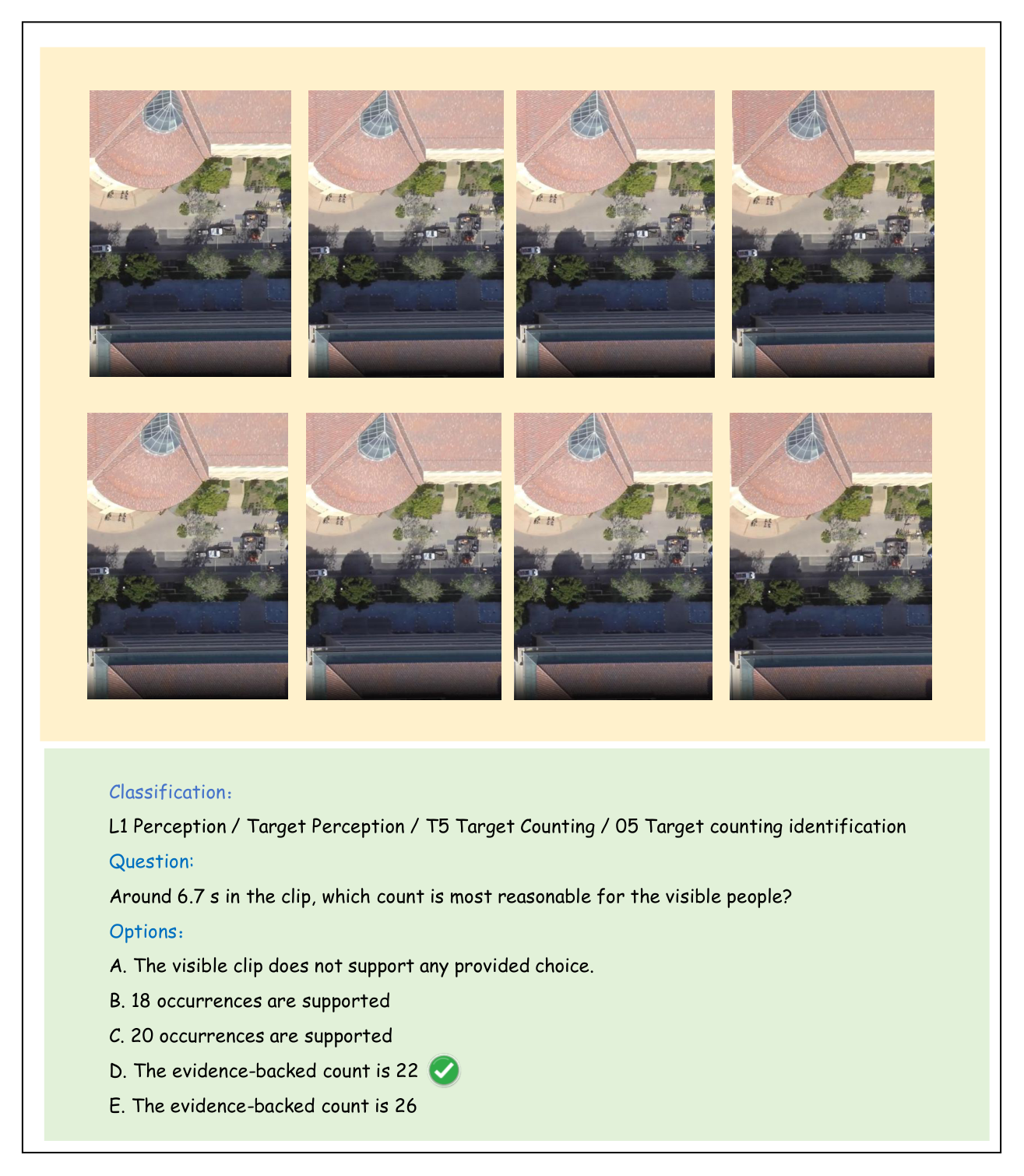
How many relevant targets are visible?
Evidence: small-object coverage across frames.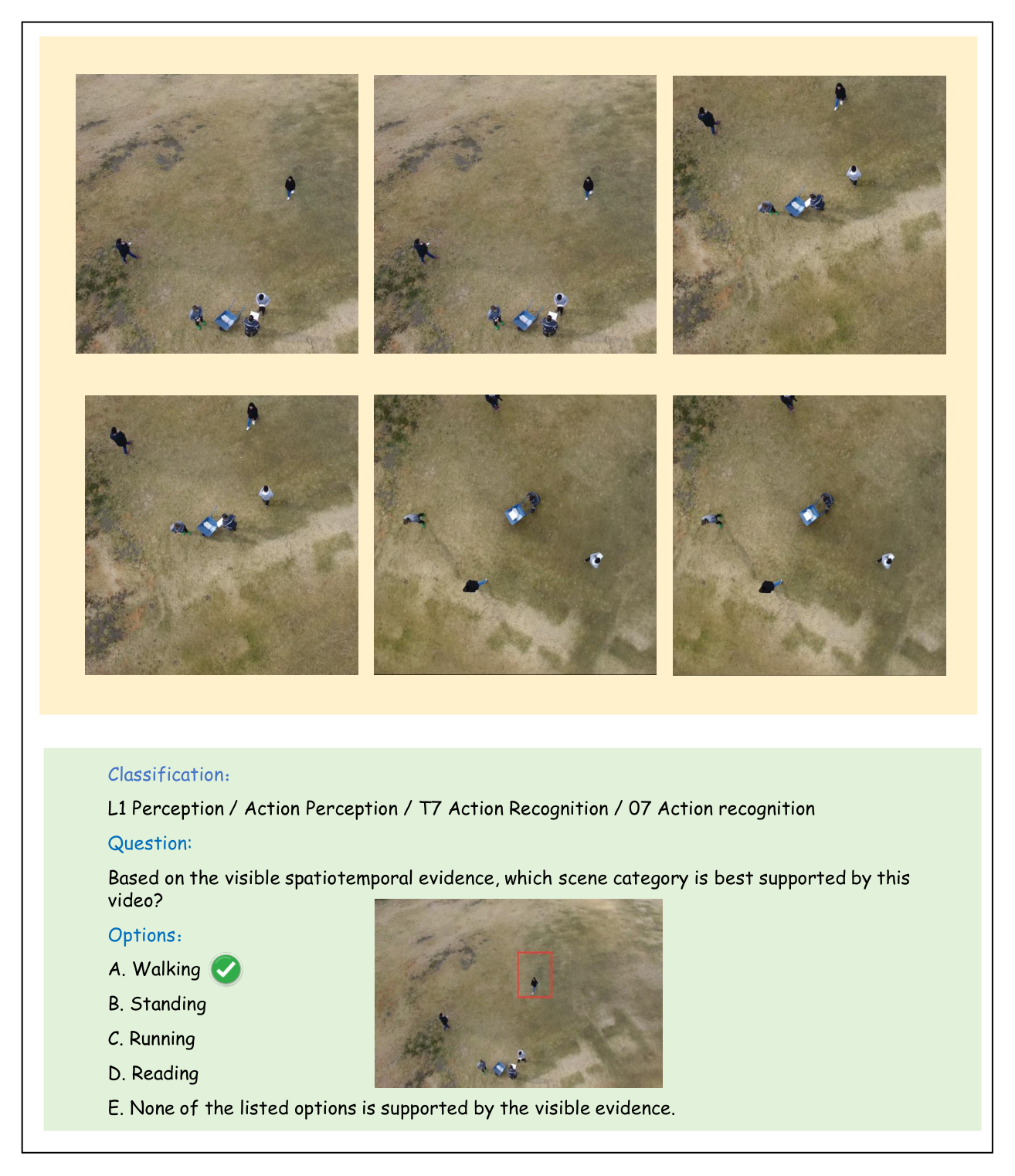
What action is taking place?
Evidence: target state and short-lived motion.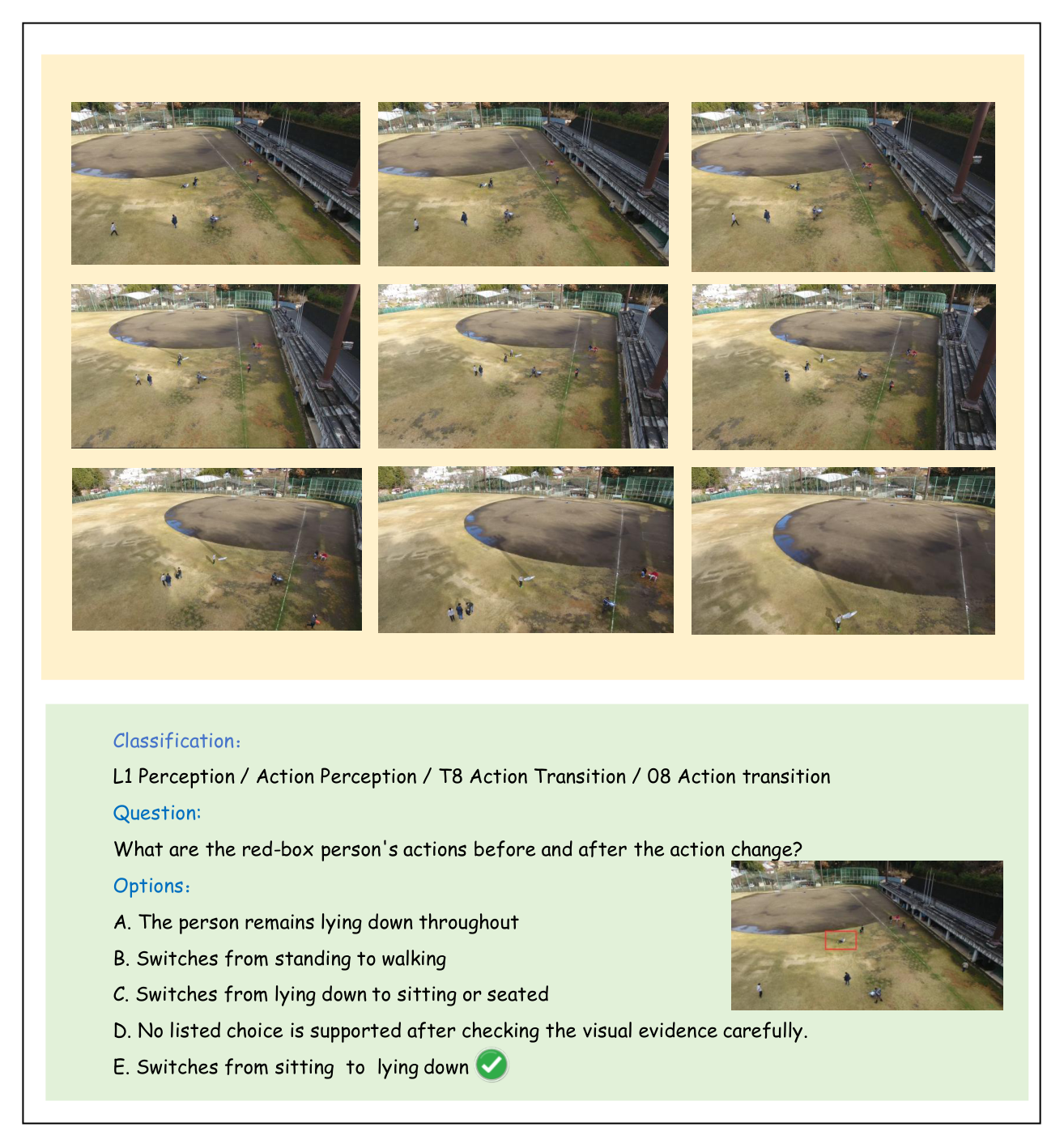
How does the target state change?
Evidence: ordered frames around the transition.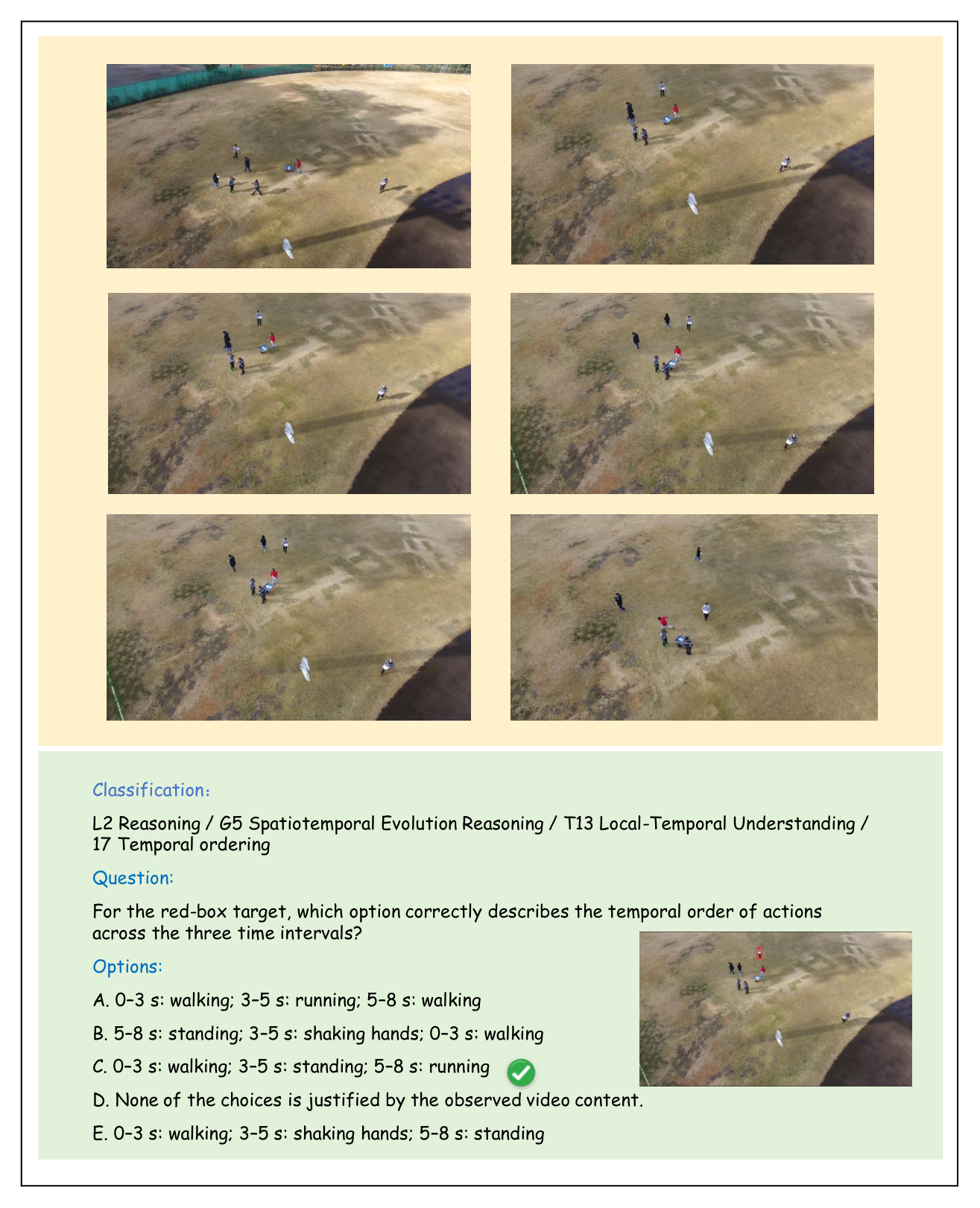
Which event happens first?
Evidence: event sequence rather than appearance alone.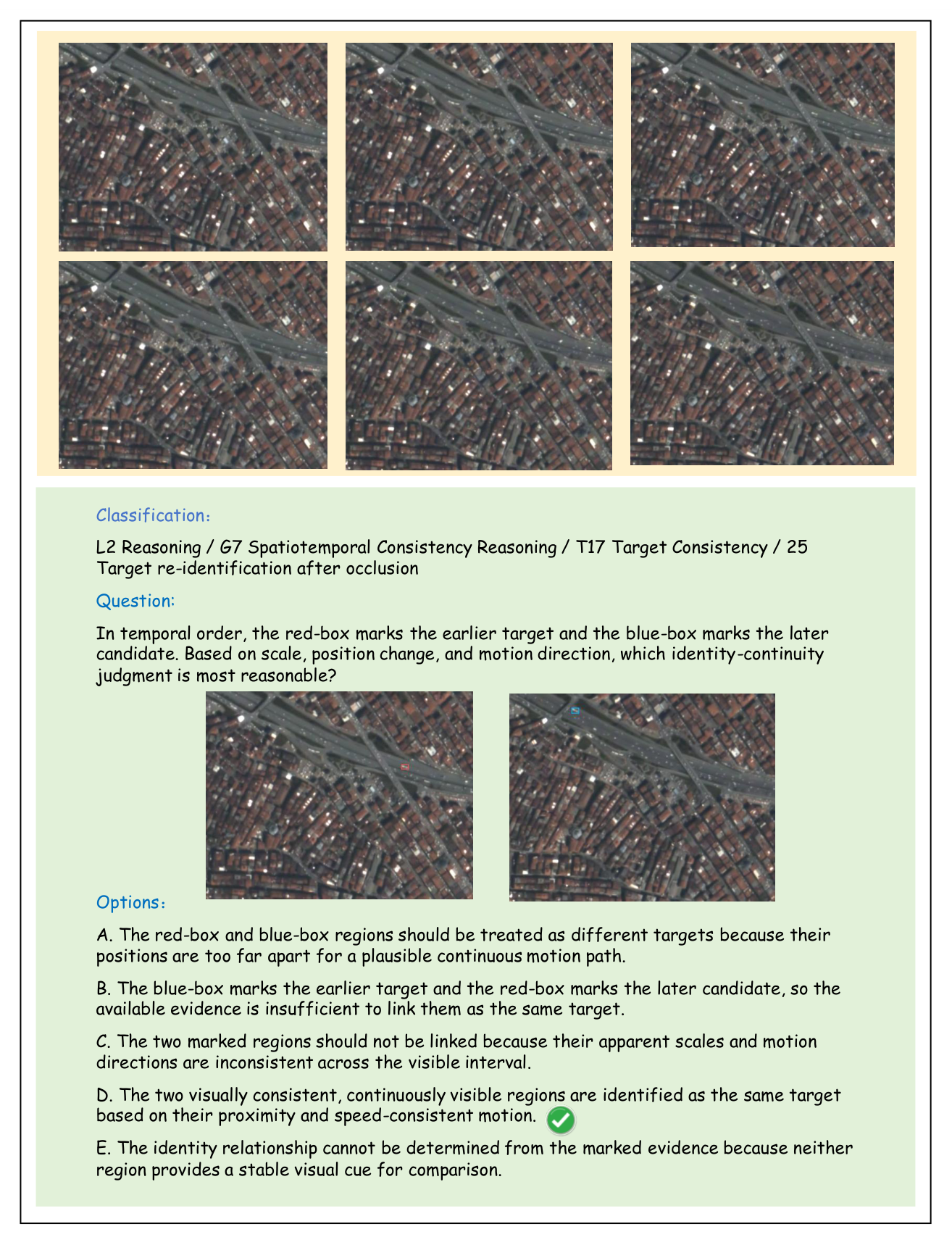
Is the target still the same object?
Evidence: identity continuity across missing views.Citation
Cite the paper from arXiv:2608.02039 or copy the BibTeX entry below.
@article{zhou2026RSVideo,
  title   = {RSVideo: Are Your Vision-Language Models Ready for Remote Sensing Videos?},
  author  = {Zhou, Hongjie and Wang, Shiqin and Chen, Haoyang and Guo, Haonan and Wang, Di and Liu, Juhua and Lin, Fu and Luo, Yong},
  journal = {arXiv preprint arXiv:2608.02039},
  year    = {2026}
}